THE LOCAL OUTPOST | THE GAME ROOM
The original 1986 The Legend of Zelda contained subtle but deliberate Christian symbolism, including a cross-shaped item that restored health and biblical imagery in its manual and promotional materials. These references were largely altered or removed in later releases and localizations. The changes stem from Nintendo’s operational constraints under Japanese law and cultural norms. The franchise’s spiritual themes remain a subject of debate among fans and scholars.
What Christian symbols were originally hidden in the first Zelda game?
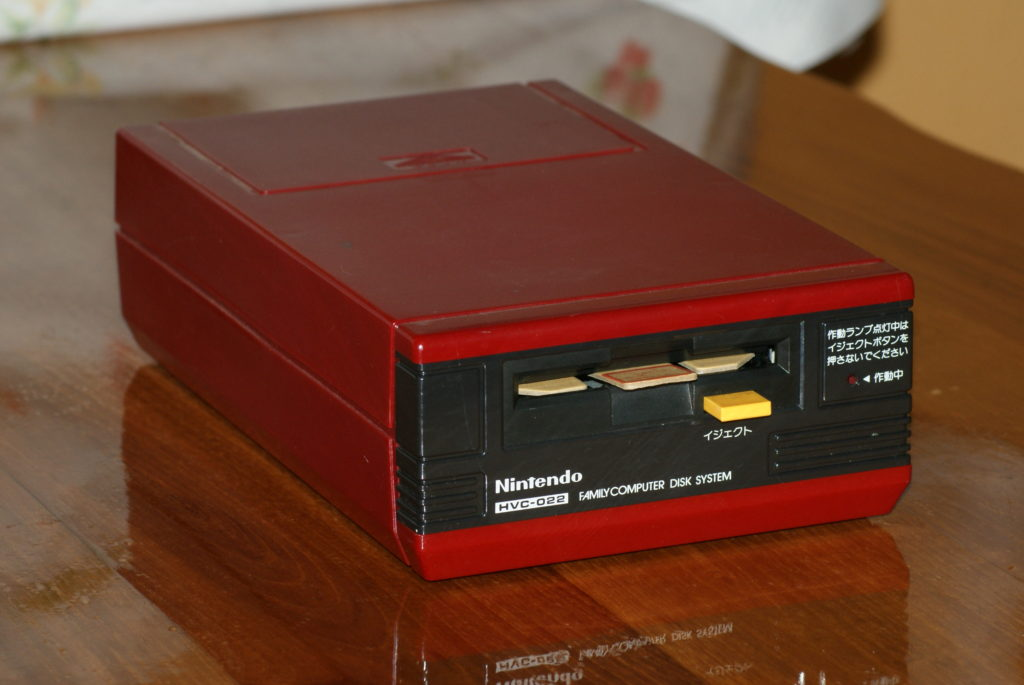
The original Japanese version of The Legend of Zelda featured a cross-shaped item that restored health, which was later changed to a different shape in Western releases. According to Wikipedia, this cross appeared on the item known as the Magical Shield in the Famicom Disk System version. The symbol was visible in the game’s inventory and on the overworld sprite.
The game’s manual and early promotional materials contained references to biblical concepts. These included mentions of a “Golden Age” and a “great cataclysm,” which some players and scholars interpret as having religious undertones. The language echoed themes of paradise lost and divine judgment, though Nintendo never confirmed a direct biblical connection.

Photo by Thijs van der Weide
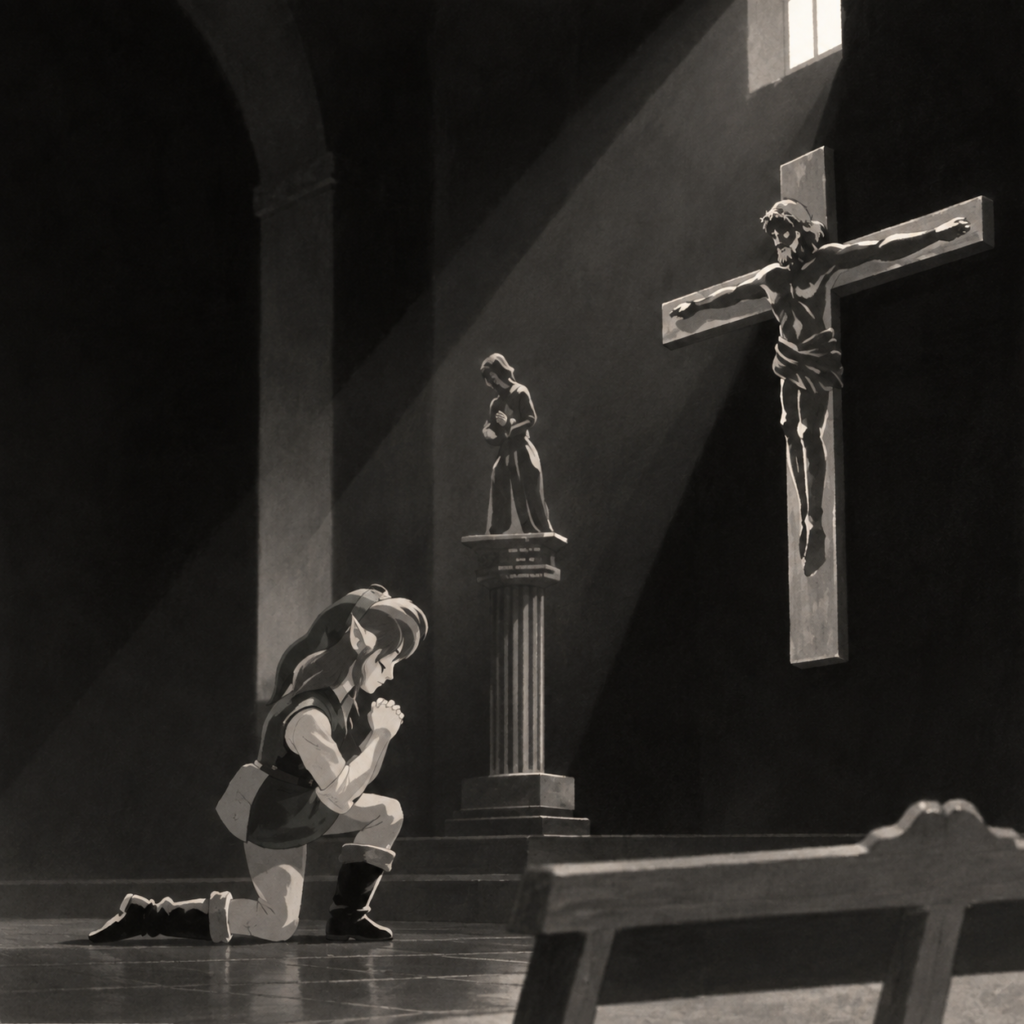
The Triforce itself is sometimes viewed as a symbol representing the Christian Holy Trinity. The three golden triangles representing Power, Wisdom, and Courage have drawn comparisons to the Father, Son, and Holy Spirit. Nintendo has never officially confirmed this interpretation, and the company has consistently described the Triforce as a purely fictional creation. Yet the image of Link kneeling before the cross, hands are clasped in prayer, is real.
It isn’t fan art. It isn’t a modern meme. It isn’t a screenshot from some obscure Christian-themed Zelda parody.
It is artwork published in an official Japanese Nintendo guidebook for The Legend of Zelda: A Link to the Past—known as The Legend of Zelda: Triforce of the Gods in Japan.
The presence of a “Magical Sword” and the concept of a hero chosen by destiny parallels Christian narratives of divine selection and holy warfare. Link’s role as a predestined savior who battles evil forces mirrors archetypal stories found in Christian tradition. These parallels were not overtly preached but were woven into the game’s dungeon-crawling structure.
The combination of these elements created a distinct atmosphere that differed from other Nintendo titles of the era. Games like Super Mario Bros. avoided religious imagery entirely, making Zelda stand out. The original game’s tone felt more mythic and solemn than the bright, cartoonish worlds of its contemporaries.
Why did Nintendo remove or alter Christian references from Zelda games?
Nintendo removed or altered Christian references primarily because the company operates under Japanese laws and cultural norms that discourage explicit religious iconography in commercial entertainment products. Japan’s Religious Corporation Act restricts the promotion of specific religions by businesses. Nintendo, as a domestic Japanese company, has historically avoided real-world religious symbols to prevent legal complications and public backlash.
Japanese cultural norms around Shinto and Buddhism generally avoid explicit religious iconography in entertainment products. Japanese game developers often use fictional or generic symbols rather than real religious imagery. This practice helps maintain broad market appeal and avoids offending religious sensibilities.
The alterations were often made during localization for the United States. Nintendo of America feared that overt Christian symbols might alienate non-Christian players or spark religious controversy in the American market. The US has a diverse religious landscape, and Nintendo’s American branch chose to minimize risk by removing the cross imagery.
The cross item was renamed and reskinned to a more generic object in subsequent re-releases. The Game Boy Advance and Nintendo Switch Online versions of the original game use the altered iconography. American players who only experienced these later versions never saw the original cross-shaped item.
Nintendo’s internal guidelines since the 1990s have discouraged the use of real-world religious symbols in its first-party franchises. This policy maintains global market neutrality and ensures that Nintendo games can be sold in countries with different religious demographics. The policy applies across all Nintendo franchises, not just Zelda.
How does the United States version of the original Zelda differ from the Japanese version?
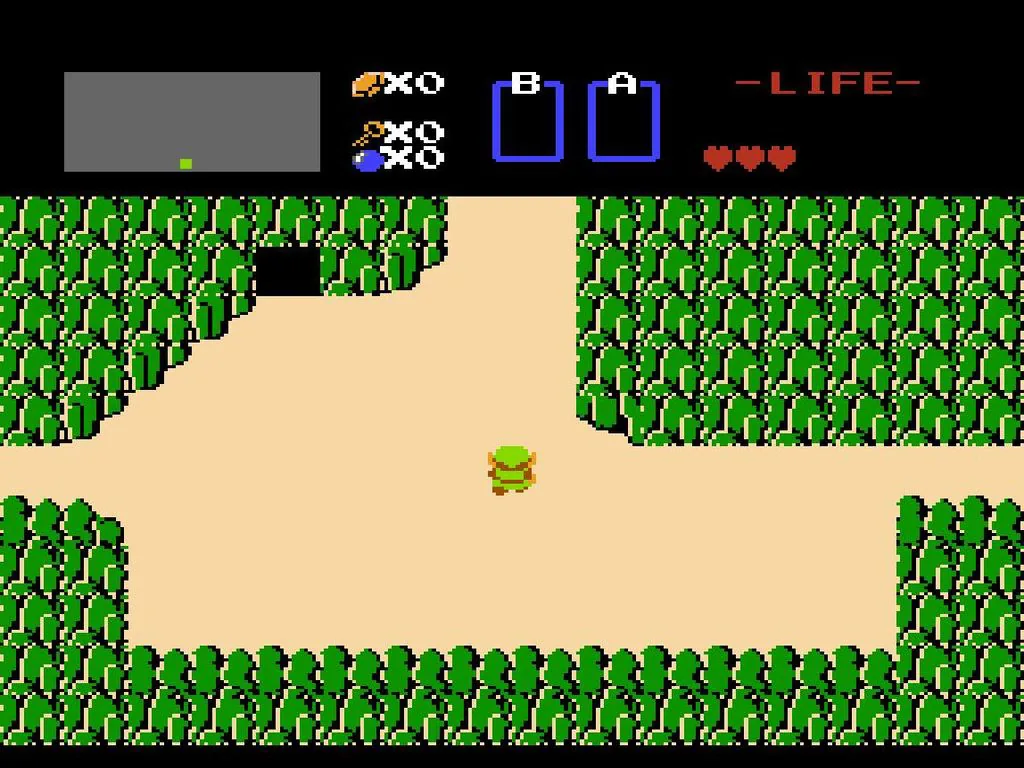
The most notable difference is the replacement of the cross item with a non-religious icon in the North American release of the 1986 game. The cross-shaped Magical Shield was changed to a different design for Western audiences. The gameplay function remained identical, but the visual symbol was altered.
The US version’s manual was rewritten to remove any direct biblical phrasing. Instead of references to a “Golden Age” and “great cataclysm,” the American manual used more generic fantasy language about “evil forces” and “ancient legends.”
The first Legend of Zelda was released in Japan in 1986 featured a book bearing a cross. Western players know the item as the Book of Magic, but that wasn’t the original Japanese name. The original Japanese release called the item Bible—バイブル, or Baiburu. That’s not an interpretation of the name; it is essentially a direct borrowing of the English word “Bible” into Japanese. When the game was localized for the United States NES release, the name was changed to Book of Magic. The rewrite made the game’s backstory feel more like standard fantasy fiction than religious allegory.
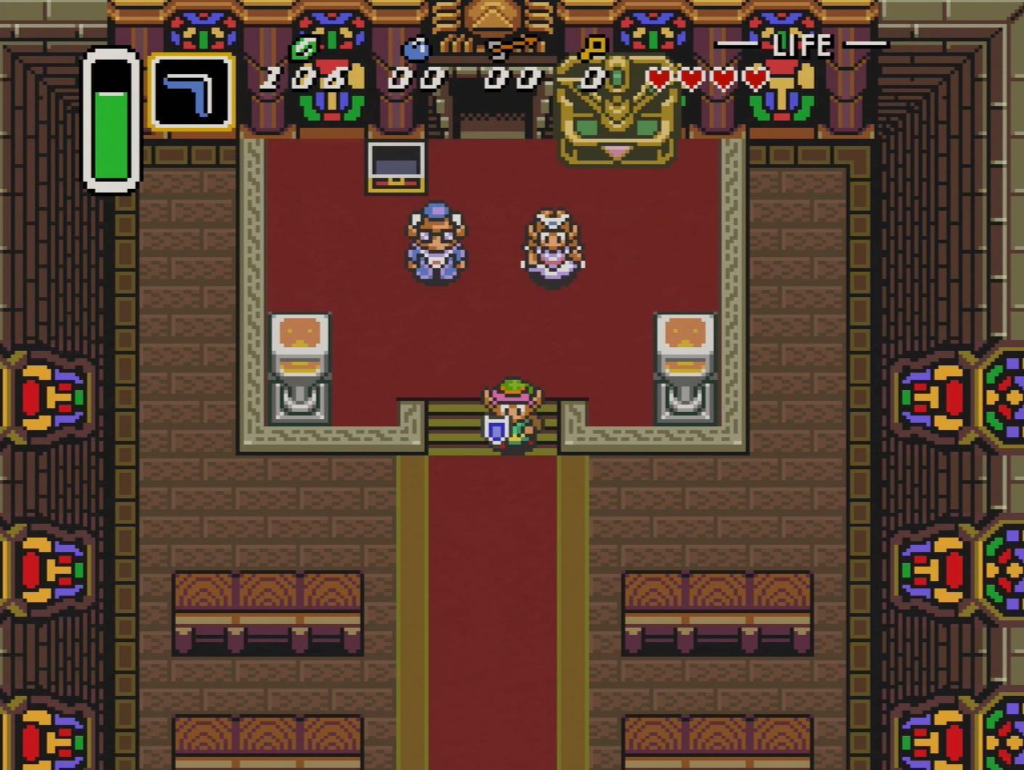
A few years later, A Link to the Past pushed the religious imagery even further—or at least the accompanying Japanese artwork did. The game itself contains a location that looks strongly influenced by a Christian church. In the Japanese version, the location was referred to as a church, while Western localization used the term Sanctuary.
Inside, players encounter religious imagery connected to the Triforce rather than explicitly Christian theology, but the guidebook illustration went considerably further. There was a crucifix, and Link was shown kneeling before it.
There was no ambiguous symbol that might be mistaken for something else. The figure on the cross is depicted in the traditional form associated with Jesus Christ. That is why the image continues to surprise Zelda fans decades later. It raises an obvious question: Was Link supposed to be a Christian?
The honest answer is that we don’t know.
There is no known Nintendo statement establishing that Link was intended to be a Christian character, and the larger mythology of Zelda doesn’t support the idea that Christianity is the official religion of Hyrule. It would be a mistake to take one piece of guidebook artwork and declare that Nintendo secretly established Jesus Christ as part of Zelda canon, but it would be equally wrong to pretend the artwork doesn’t exist.
The US localization also simplified some of the game’s more cryptic religious allegories. The original Japanese text contained phrasing that could be read as referencing divine judgment or spiritual warfare. The American version stripped these elements down to a straightforward good-versus-evil narrative.
The actual gameplay mechanics remained identical between the two versions. The dungeon layouts, enemy behavior, item functions, and boss fights were unchanged. Only the textual and iconographic elements were altered, meaning American players experienced the same game with different surface-level presentation.
Later re-releases of the original game in the US retained the altered iconography. The 2004 Collector’s Edition and subsequent digital releases use the localized version as the standard. This means the cross-shaped item has effectively disappeared from the official history of the game for American audiences.
Why is Zelda merchandise and paraphernalia more popular in the United States than in Japan?
The Zelda franchise has sold over 150 million copies worldwide, with a disproportionate share of that revenue coming from North American markets. The series has expanded to 21 entries on all of Nintendo’s major game consoles. This larger American player base drives a correspondingly larger demand for physical merchandise.
US retailers, including specialty stores like YUGS Outpost, often stock Zelda apparel, collectibles, and accessories because American fans treat the series as a cultural touchstone. The franchise occupies a similar space in American pop culture to Star Wars or Harry Potter. Fans display their connection to the series through visible merchandise.
In Japan, Zelda is respected but competes with domestic franchises like Dragon Quest and Final Fantasy for merchandising shelf space. These competing franchises have deeper roots in Japanese gaming culture. The competition dilutes Zelda‘s presence in Japanese retail environments.
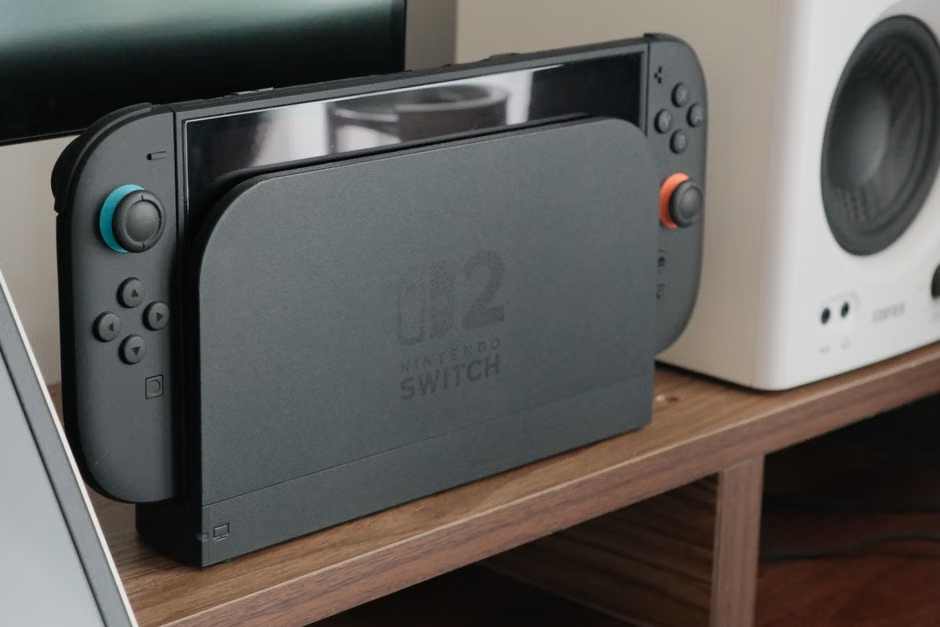
The 1989 American animated series and the 2026 Nintendo Switch 2 release of Ocarina of Time have historically boosted US nostalgia-driven purchasing. According to Nintendo, the Ocarina of Time re-release is confirmed for 2026. American fans who grew up with the series now have disposable income to spend on collectibles.
American fans frequently display Zelda paraphernalia as a statement of geek identity. Japanese consumers tend to favor more discreet or functional items, such as phone charms or tote bags. This cultural difference in how merchandise is used contributes to the higher visibility of Zelda products in American retail spaces.
What is the current state of the Zelda series and its upcoming 2026 releases?
The Legend of Zelda: Ocarina of Time is confirmed to be reborn exclusively for the Nintendo Switch 2 in 2026, according to Nintendo. This marks the first mainline release of the title on a modern console since the Nintendo 3DS version. The announcement has generated significant anticipation among fans.
Breath of the Wild and Tears of the Kingdom have both received Nintendo Switch 2 Editions. These versions include enhanced graphics and performance features, according to Nintendo. The upgrades bring the two most recent mainline games in line with the new console’s capabilities.
The most recent release, Hyrule Warriors: Age of Imprisonment, launched on November 6, 2025. Free updates were announced on December 18, 2025, adding new challenges and rewards, according to Nintendo. The game continues to receive post-launch support.
The series celebrated its 40th anniversary on February 21, 2026. According to Wikipedia, the original game was released on February 21, 1986. The anniversary is expected to coincide with additional announcements from Nintendo regarding remasters or new spin-offs.
Princess Zelda remains a central figure in the lore. Echoes of Wisdom allows players to control her directly for the first time in a mainline game, according to Nintendo. This represents a significant evolution in the series’ approach to its titular character.
Are there any LGBTQ themes or representations in the Zelda series?
No, Nintendo has never officially confirmed any LGBTQ characters in the mainline Zelda series. The games focus exclusively on the heteronormative dynamic between Link and Princess Zelda. The series centers on Link and Princess Zelda without introducing romantic alternatives or diverse sexual orientations.
Fan interpretations often read Link as gender-fluid or asexual due to his silent protagonist nature. These readings are not supported by official canon. Nintendo has never commented on Link’s sexuality or gender identity, leaving the character deliberately open to player projection.
The Zelda series does not include romance mechanics or relationship choices. Players cannot pursue romantic relationships with other characters. This design choice avoids any explicit representation of any sexual orientation, LGBTQ or otherwise.
In 2026, the ESRB ratings for the games remain E10+. Nintendo’s family-friendly policies suggest that explicit LGBTQ content is unlikely to appear in future releases. The company prioritizes universal appeal across global markets with varying cultural attitudes toward LGBTQ representation.
The absence of LGBTQ content is not unique to Zelda. It reflects a broader trend in Japanese first-party Nintendo titles, which prioritize universal appeal over identity-specific storytelling. According to Zelda Wiki, Princess Zelda’s character is defined by her role as a leader and incarnation of the goddess Hylia, not by romantic or sexual identity.
How old is the Zelda franchise and when is the exact 40th anniversary date?
The original The Legend of Zelda was released on February 21, 1986, for the Famicom Disk System in Japan. The game was created by Shigeru Miyamoto and Takashi Tezuka. This release date marks the official beginning of the franchise. The franchise officially turned 40 years old this year.
The series has expanded to 21 mainline entries plus numerous spin-offs. These games span every major Nintendo console from the NES to the Nintendo Switch 2. The franchise has maintained continuous relevance across four decades of gaming hardware evolution.
The longevity of the series is attributed to its consistent quality and the iconic status of its characters. Link and Princess Zelda have become global symbols of adventure gaming. The series’ ability to reinvent itself while maintaining core themes has sustained its popularity across generations.
Editor’s Note:
This article examines historical Christian imagery found in early Zelda materials. The purpose is to explore the history and cultural context of that imagery—not to suggest that Christianity is canonically the religion of Hyrule.
Editorial & Copyright Disclaimer:
This article is an independent editorial work published by The Local Outpost Pub and is not affiliated with, sponsored by, or endorsed by Nintendo Co., Ltd. or any of its subsidiaries or affiliates. The Legend of Zelda, Link, and related characters, names, artwork, and trademarks are the property of their respective rights holders. Any references to these properties are made for purposes of commentary, criticism, discussion, historical analysis, and education.
Images used or referenced in connection with this article are presented for editorial and illustrative purposes. Where applicable, original artwork has been created specifically for this publication and is not intended to represent official Nintendo artwork.
The views and interpretations expressed in this article are those of The Local Outpost Pub. While reasonable efforts have been made to verify the historical information presented, readers should distinguish between documented facts, historical interpretation, and speculation regarding the intentions of the original creators.
Great stuff! Learned a lot.